Is code written with AI safe? How we test and review every change
Code written with AI is as safe as the checks it passes. The path every change takes before it ships, and what you can check yourself.
· 6 min read
AI changed how code gets written. It did not change who answers for it.
Code has never been easier to produce. That is good news for anyone with an idea, and it is exactly why the work that comes after the code matters more than it used to. A change that nobody tested or read can look finished and still break the checkout, expose a key or quietly undo last month’s fix.
So is code written with AI safe? It is as safe as the checks it passes before it reaches your product, and the people who answer for it. Our developers build with AI and review every line. Here is what that means for every change we make, and what you can check yourself, whoever builds your product.
In short
- Code written with AI is as safe as the checks around it. Every change should pass automated tests and automated code review, and a developer should read it before it ships.
- Tests check what someone thought to test. A person’s review catches the rest: the wrong problem solved well, a key in the wrong place, code the next developer cannot follow.
- Someone has to answer for every change. People decide what ships, and people answer for it, whatever tools they use.
- You can check it yourself: the code in your own repository, the history of every change and who reviewed it, the tests that run on it, and a new build to try every week.
The path every change takes
At MobiStack Digital, every change to a product we build or look after takes the same path:
- A reason. Every change starts with what it has to do for the business: fix a crash, remove a step people give up on, make releases safer. If we cannot say why a change matters, we do not make it.
- The build. One of our developers builds the change, with AI among the tools, inside the architecture we set for the product.
- Automated tests. The product’s tests run against the change. A fix comes with a test that proves the problem is gone, so it stays fixed.
- Automated code review. A second set of automated checks looks for common mistakes, security problems and code that does not follow the product’s conventions.
- A person reads it. One of our developers reads the change, line by line, before it ships. A change nobody read does not ship.
- A build you can try. The change goes into the next build, and you try it yourself, on your phone or in your browser.
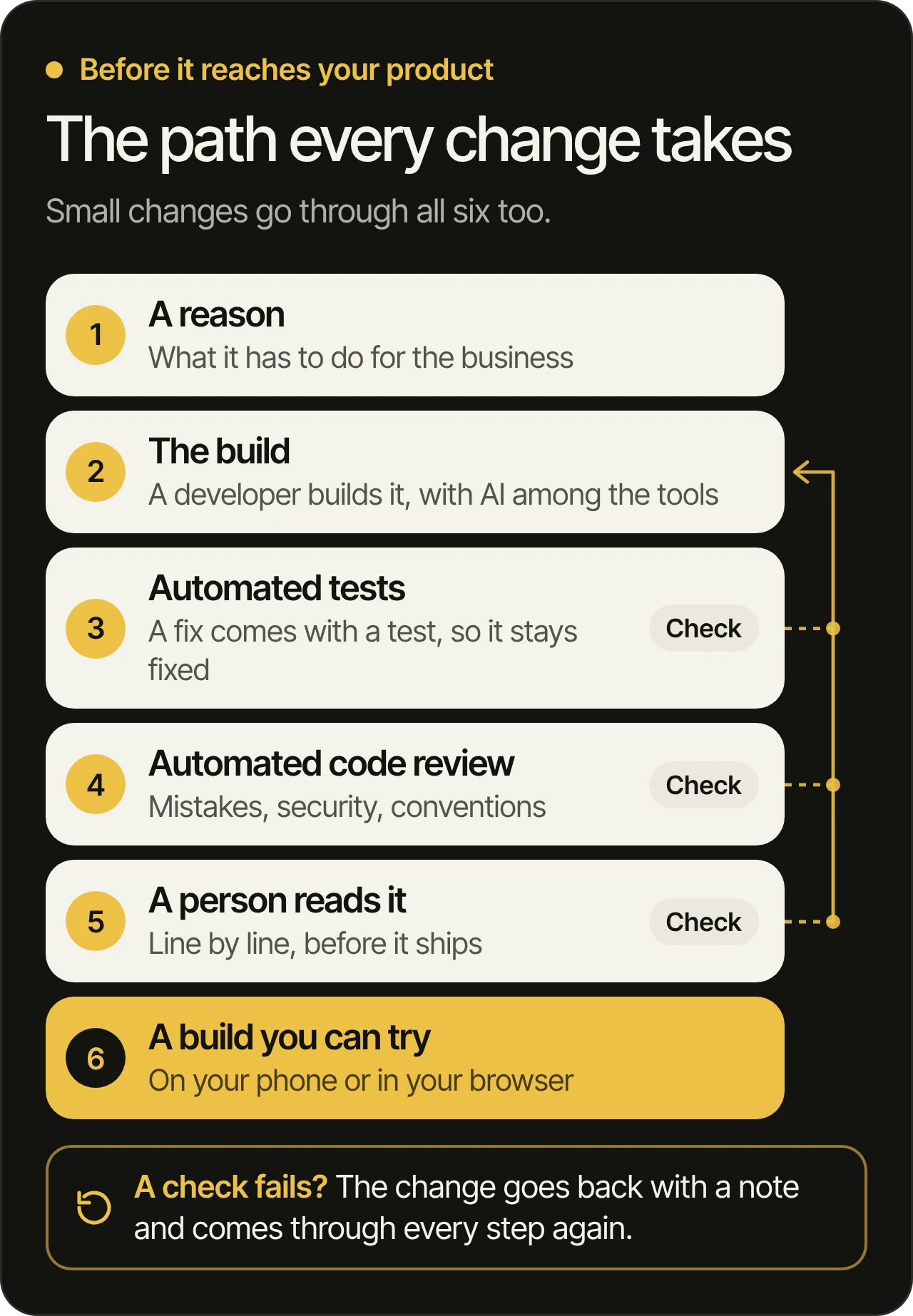
None of these steps is optional, and none of them waits for the end of a project. Small changes go through all six too, because small changes are where surprises hide.
Why tests come first
A fix without a test tends to be a fix you make twice. Products change all the time, and the same bug finds its way back through an update that seemed unrelated.
So when we fix a crash or a broken flow, we first write a test that shows the problem, then make the test pass. From then on, every change to the product runs that test again. Over time the tests become a record of everything that has gone wrong before, and a guard against it going wrong again.
Tests also make every later change safer. With them, changing a screen no longer means hoping nothing else breaks.
Why a person still reads every line
Tests only check what someone thought to test. A review by a person catches the rest:
- Does it do what the business needed? Code can pass every test and still solve the wrong problem.
- Is it safe? A key in the wrong place, data shown to the wrong user, an input nobody checks. These are the kinds of risks the OWASP Top 10 (opens in a new tab) lists for web applications, and a reviewer looks for them in every change.
- Will the next person understand it? Code is read far more often than it is written, and code nobody can follow becomes the next takeover.
- Does it fit? A change that ignores the product’s architecture works today and makes every later change harder.
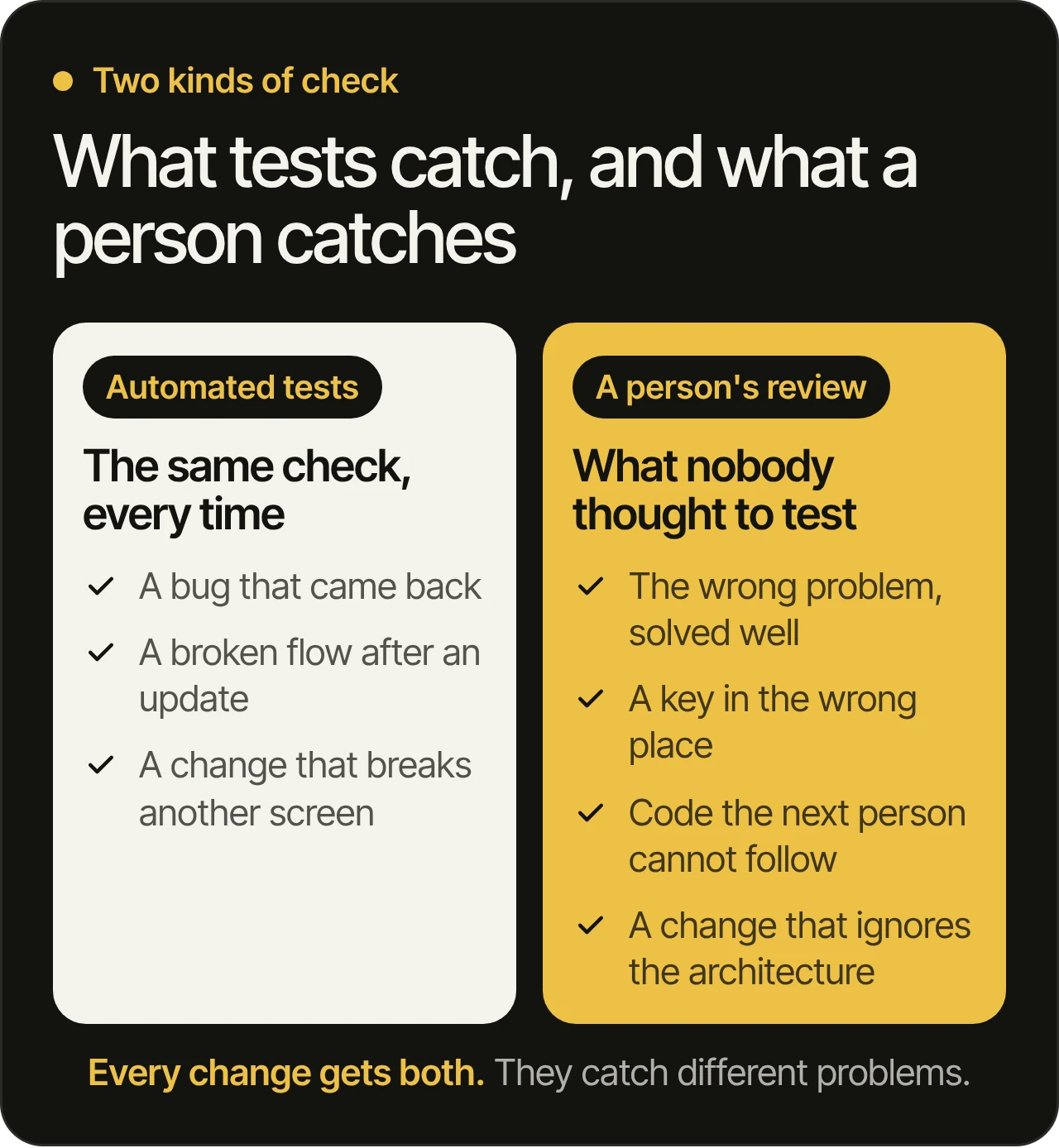
The reviewer checks the change against the reason it was made, and against what it must not touch. When something does not fit, the change goes back with a note and comes through the same steps again.
This is the part that does not get easier with better tools. It takes judgment, and someone who answers for the result.
What you can check yourself
You do not have to take any of this on trust, from us or from anyone else who builds your product. You can see it:
- The code lives in your own repository, in an account your company owns, with the history of every change.
- Each change arrives as a reviewed request that shows who changed what, and who approved it. A protected branch (opens in a new tab) can require a review and passing checks before anything merges.
- The tests run on every change, and their results sit next to it.
- You get a new build to try every week (on a takeover, once the code and accounts are in your name).
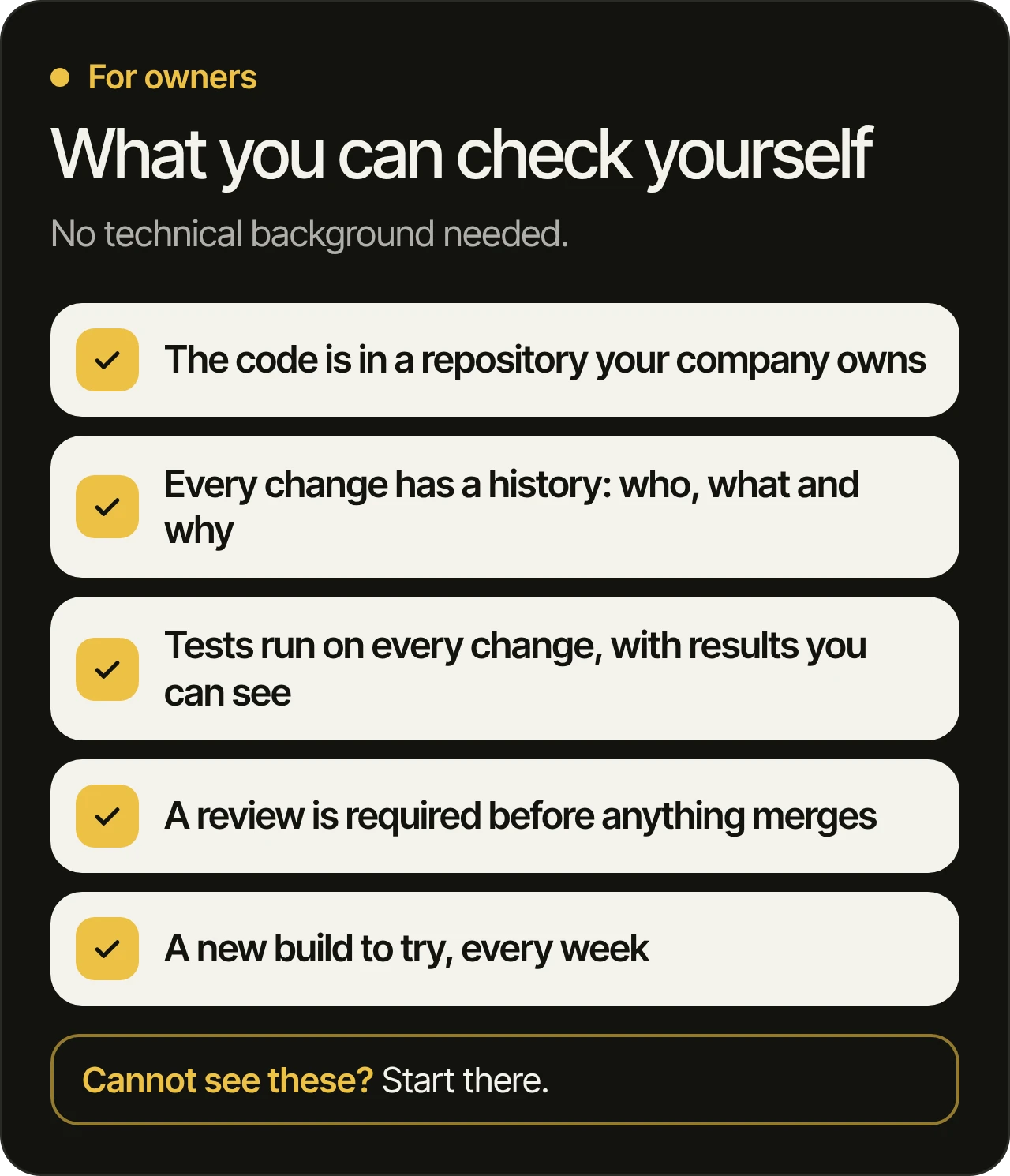
When a test, a check or a reviewer finds something wrong, the change does not ship until it is fixed. That is the whole point of the process.
Questions to ask any team that builds with AI
Whoever builds your product, these five questions tell you most of what you need to know:
- Who reads each change before it ships?
- Which tests run on every change, and where can we see the results?
- Where does the code live, and is that account in our name?
- What happens when a check fails?
- How do you keep passwords and keys out of the code?
Clear, specific answers are a good sign. Vague ones are worth a second conversation.
Questions owners ask
Is code written with AI safe to use in a live product?
It can be, when it passes the same checks as any other code and someone answers for it. The risk is code that nobody tested or read. Our developers build with AI and review every line. A change nobody read does not ship.
What does a code review check?
Whether the change does what the business needed, whether it is safe, whether the next developer will understand it, and whether it fits the product’s architecture. Tests cannot answer most of these, which is why a person still reads every change.
Why do tests matter if a person reviews every change?
People miss things, especially in a long change. Tests check the same things the same way every time, and a test written for a fixed bug keeps it from coming back. The two catch different problems, so a change needs both.
Who is responsible when code breaks?
The people who shipped it. AI changed how code gets written. It did not change who answers for it. When we ship a change, one of our developers has read it and answers for it.
How can we tell whether our developers test and review their work?
Ask to see the repository and the history of a recent change: who made it, who reviewed it and which tests ran. If the code is not in an account you own, or nobody can show you a review, that is the first thing to fix, and it is where a takeover starts.
Bring us your product
If you want developers who answer for every line in your product, book a free 45-minute consultation. We go through your product before the call, then show you what we would fix first, and how. You can also read how we work and how we decide what to fix first, or see our services.