Web development in Beirut: do you need a website or a platform?
Shopping for web development in Beirut? How to tell whether your business needs a website or a web platform, and what to ask the team.
· 8 min read
You are looking for web development in Beirut, and every proposal says “website”. But your orders arrive as messages, your bookings live in a spreadsheet and customers keep asking where their order is. Whether you need a website or a web platform decides what you should buy and who should build it. MobiStack Digital takes over, fixes and builds mobile apps and web platforms, and this is how we would tell the two jobs apart, and what we would ask a team before signing.
In short
- A website tells people about your business. A web platform lets them act. Customers or staff sign in, order, book, pay or track something, and your team manages it behind the scenes.
- Look at how work reaches you today. If orders come as messages and staff retype them into a spreadsheet, the work already runs on software you did not choose. A platform puts it in one place that you own.
- A platform needs a team that builds and maintains software. Pages can be designed once. Accounts, payments and who sees what need testing, review and care after launch.
- Settle payments, languages and ownership before you compare proposals. The domain, hosting, code and admin logins should be in your company’s name from the first day.
What is the difference between a website and a web platform?
A website presents your business: pages people read, a contact form, a map. A web platform is software people use. They sign in, place orders, book, pay or track something, and your staff manage it behind the scenes. The test is simple: does anything change when a visitor acts, and does someone on your team need to see it?
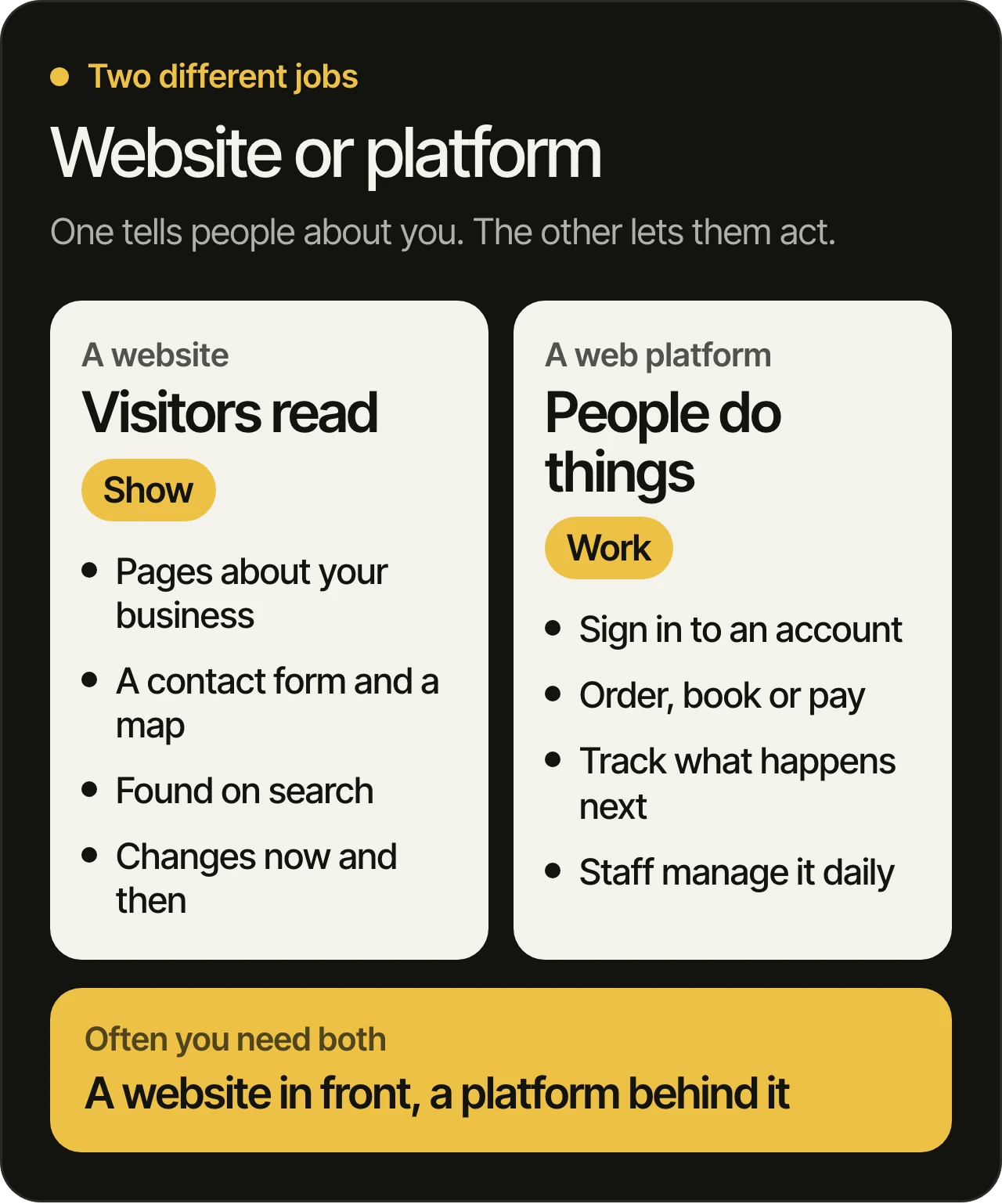
The two are judged differently. A website succeeds when the right people find it and understand what you offer. A platform succeeds when work gets done without mistakes: the right order reaches the right person, the payment matches, and one customer never sees another customer’s details. Those need different skills, so a team that is good at one is not automatically good at the other.
If you need a website, ask what the team does for search. Google’s SEO Starter Guide (opens in a new tab) asks for the basics: a title that is “unique to the page, clear and concise”, a short description unique to each page, and web addresses with words that are useful to users. It also says a sitemap is not required, and that no site is certain to be added to Google’s index. Be careful with anyone who promises a ranking.
Which signs say your business needs a platform?
Your business needs a platform when the work already happens in messages, spreadsheets and phone calls, and people wait on each other to move it along. If orders arrive as messages, bookings are confirmed by hand, staff copy details between chats and sheets, or customers ask where their order is, a platform puts all of it in one place.
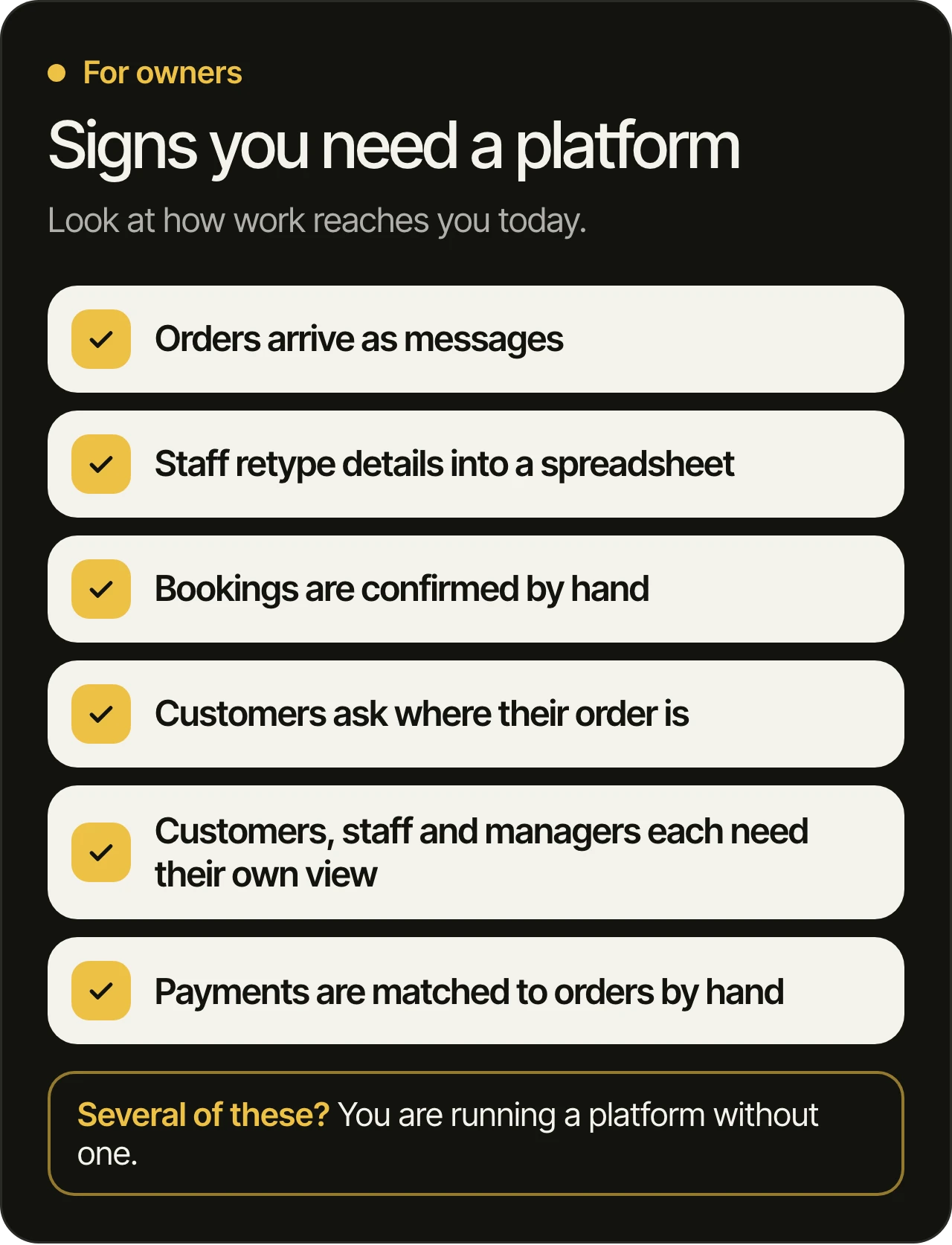
Three more questions help:
- Does anyone need to sign in? Accounts, order history and staff logins are platform features.
- Does one action start another? A booking that sends a confirmation, updates a calendar and tells the right person is a platform. A form that emails you is a website.
- Who has to see what? If customers, staff and managers each need a different view of the same data, you need a platform.
If none of these fit, a good website is the right answer, and a team that tells you so is worth trusting. If some do, our post on what goes into the first version of an app shows how to choose what comes first. The same thinking applies to a platform.
What should a Beirut team ask about payments and languages?
Ask how your customers actually pay, and which language each person using the platform reads. A team that starts designing before it asks is guessing. Payment methods and the languages on screen shape the layout, the data and the checkout, and both are hard to add late.
On payments, a good team asks:
- How do customers pay today, and which of those ways must the platform support?
- Who confirms that a payment arrived, and what happens when one fails or is refunded?
- Which account does the money go to? It should belong to your company.
On languages, it asks:
- Which screens must be in Arabic, English or French, and who writes the text? Each language needs words written by a native reader, not a translation tool.
- Does the Arabic version get a true right to left layout? Our post on how to judge a UI/UX agency from its portfolio explains what flips and what stays.
- What does a customer see when their language is not ready yet?
Customers in Lebanon also meet weak connections and several languages in the same app. The same questions apply on the web, and we cover them in mobile app development in Lebanon.
Where should it be hosted, and who owns the accounts?
Hosting should run in an account in your company’s name. The domain should be registered to your company, and the code should sit in a repository your company owns. The team works inside those accounts with access you can remove. If any of them sit with the developer, you depend on that person for every change.
Check six things before you sign:
- The domain. Registered by your company, with your email as the owner.
- Hosting. An account in your company’s name, with the team added as users.
- The code. A repository your company owns, with its history.
- The database and backups. Where your customers’ data lives, and who can restore it.
- The payment account. Registered to your company, so payouts reach you directly.
- Admin logins. Each person has their own, and you hold the owner login.
We keep code, accounts and store listings in your name, and we think every owner should ask the same of any team.
What does it take to keep a platform running?
A platform needs care after launch: fixes for what breaks, updates for what ages and checks on who can see what. It holds your customers’ accounts and orders, so a stopped project can leave the business stuck. Ask who looks after it, and how every change is tested and reviewed before it reaches customers.
Security is a fair question to put to any team. The OWASP Top 10 (opens in a new tab) is, in its own words, “a standard awareness document for developers and web application security”. The 2025 edition lists broken access control, security misconfiguration, injection and authentication failures among its categories. In an owner’s words: can one customer see another customer’s order, are the settings safe, and is sign-in protected? A good team can answer all three in plain words.
On our side, our developers build with AI and review every line. Every change passes automated tests and automated code review, and one of our developers reads it before it ships. A change nobody read does not ship. The post is code written with AI safe explains how it works.
How do you compare proposals?
Compare what each proposal says about the work after the first release, not only the pages it lists. Look for the problem it solves in your words, what is built first, who owns what, how a change is checked and who looks after the platform. A proposal that lists screens and skips these has described the pages and left the platform out.
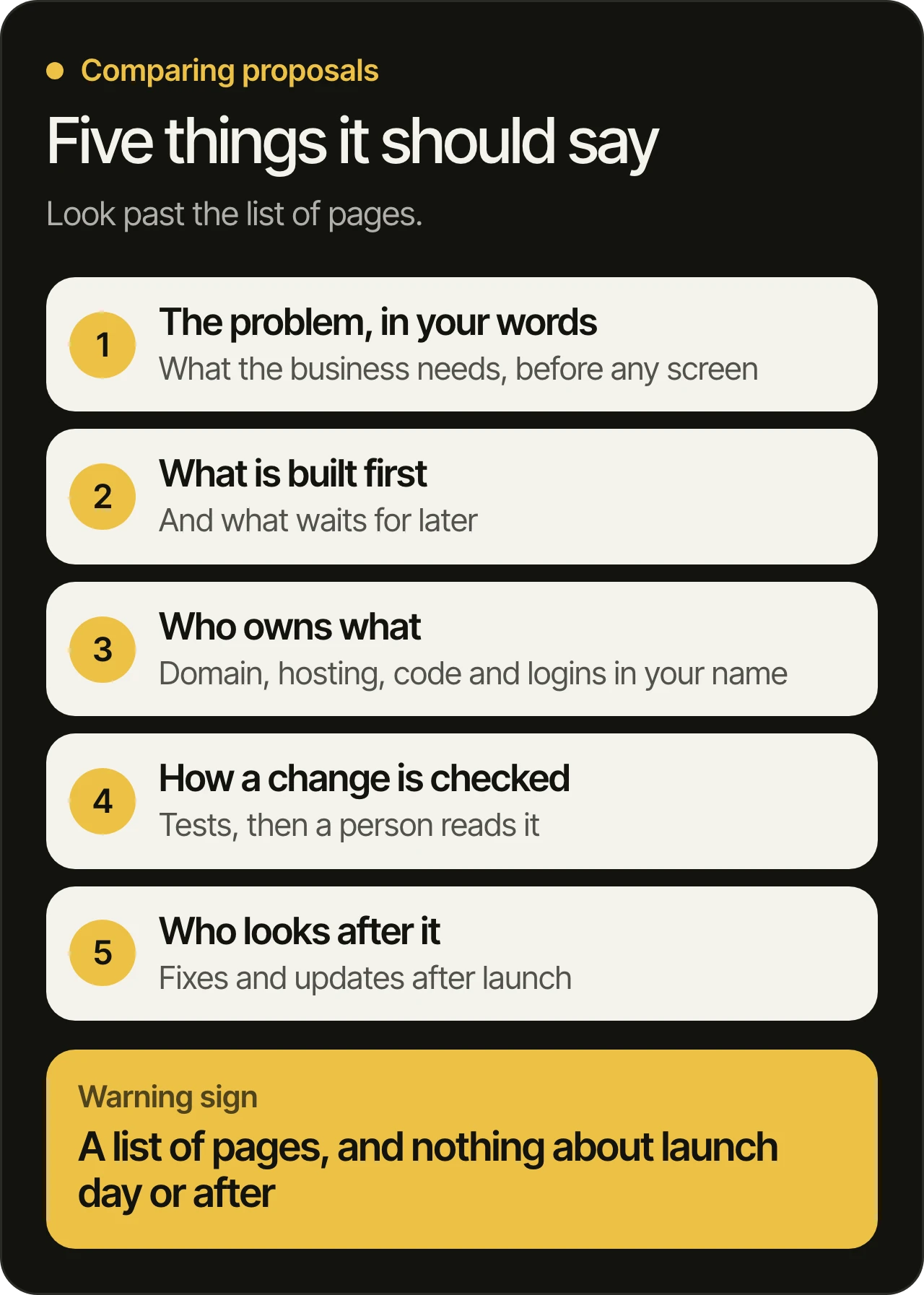
Ask each team the same questions in writing and compare the answers side by side. A team that is confident in its work will not mind. If you already have a platform that a previous team built and want a new team to take it on, read taking over an app from another developer. A takeover starts with a written audit, and the same steps work for a web platform.
Questions owners ask
Can a website grow into a platform later?
Often, if the first version is built with that in mind. A brochure site made from a template usually cannot take sign-in, orders or payments, so the platform is built beside it or in its place. Say at the start where you want the business to go, and ask the team how they would get there.
Do we need an app as well?
Not always. A platform that works well in a phone browser covers many businesses. An app makes sense when customers come back often or you need what the phone itself offers. Start with the job the platform must do, then ask whether an app would serve customers better.
Who should own the domain and hosting?
Your company. Register the domain and open the hosting account under your own name and email, then add the team as users. That way you can change teams without asking anyone’s permission, and no one else holds the keys.
Can the platform work in Arabic, English and French?
Yes, if it is planned from the first screen. Each language needs text written by someone who reads it natively, and Arabic needs a right to left layout designed on purpose, not flipped at the end. Decide which language comes first and which follow, so the team can build for all of them.
What happens if the developer leaves?
If the code, accounts and logins are in your name and the work is written down, a new team can continue. If they are not, you may be stuck. This is why we start every takeover with a written audit, and why ownership belongs in the first conversation, not the last.
Choosing a web team in Beirut?
Book a free 45-minute consultation. We go through your product before the call. We have been building products since 2021, and products our team has built are used by more than a million people. Our office is in Dubai, and our team works remotely in Beirut. Read more on our web platform development page and our Beirut page.